AI Laboratories and Paleontology – The Future Intersection
How AI Laboratories are Revolutionizing Paleontology
For over 150 years, paleontology has been the meticulous science of digging up fossils and piecing together the story of ancient life. While technological advancements have aided fossil hunters and data analysts over time, the integration of Artificial Intelligence (AI) into paleontological research marks a paradigm shift. Today, specialized AI laboratories are not just crunching numbers; they are actively participating in the discovery process, analysis, and interpretation of paleontological data. This burgeoning synergy between AI and paleontology is unlocking new possibilities and
rewriting the future of understanding our planet’s deep history. This article delves into the fascinating intersection of AI laboratories and paleontology, exploring current applications and the exciting possibilities on the horizon.
AI in Action – Current Applications
AI laboratories, often employing large language models (LLMs) and specialized computer vision algorithms, are tackling complex problems in paleontology. One of the most significant contributions is enhanced data analysis. Traditional methods of cataloging fossils, comparing species, and interpreting geological data are time-consuming and prone to human error or oversight. AI can process vast datasets – from high-resolution scans of fossil collections to geological
surveys and paleoclimate models – far faster and with greater consistency. For instance, AI can analyze thousands of fossil images to identify subtle morphological differences between specimens, potentially discovering new species or clarifying evolutionary relationships much quicker than manual methods. AI labs are also developing sophisticated tools for predictive modeling. By analyzing patterns in fossil distributions, geological formations, and climate data, AI can help paleontologists model past environments and predict where undiscovered fossils might be located, guiding excavation efforts more effectively.
Beyond the Data – Interpreting the Past
Beyond mere data processing, AI labs are contributing to pattern recognition and interpretation. They can analyze fossil layering (biostratigraphy) to date rock layers more accurately or identify subtle correlations between fossil types and specific paleoenvironmental conditions. AI is also being used to generate plausible reconstructions of ancient ecosystems and environments based on fragmentary fossil evidence, helping researchers visualize scenarios and test hypotheses. Furthermore, AI labs are tackling the challenge of information overload. Digitized fossil collections worldwide contain millions of records. AI can sift through this data to provide researchers with targeted insights, answer specific questions about evolutionary trends, or even help identify biases in existing fossil records. Some labs are even exploring the use of AI to translate complex paleontological findings into accessible formats for education, creating interactive visualizations or summaries for museums and the public.
Popular Topics & Future Horizons
Several key topics at the intersection of AI labs and paleontology are capturing significant attention:
- AI-Powered Discovery: Using machine learning to scan vast digital archives or geological data to predict novel fossil finds or unrecognized species.
- Automated Fossil Identification: Developing algorithms that can automatically identify species from fossil fragments, speeding up cataloging and research.
- Climate Change Reconstruction: Using AI to analyze fossil data (e.g., pollen, ancient plant/fauna distributions, oxygen isotopes in shells) to build highly detailed models of past climates and predict future changes.
- Virtual Fossil Museums: Creating immersive, AI-curated digital experiences where users can explore fossils, environments, and evolutionary timelines.
- AI for Conservation: Applying predictive modeling to anticipate threats to fossil sites due to climate change or human activity, aiding in their preservation.
- Integrating LLMs with Scientific Literature: Using large language models to rapidly synthesize knowledge from millions of scientific papers on paleontology, helping researchers stay informed and identify new research directions.
Looking ahead, the future promises even deeper integration:
- More Sophisticated Predictive Models: AI will become better at simulating complex interactions between organisms and ancient environments.
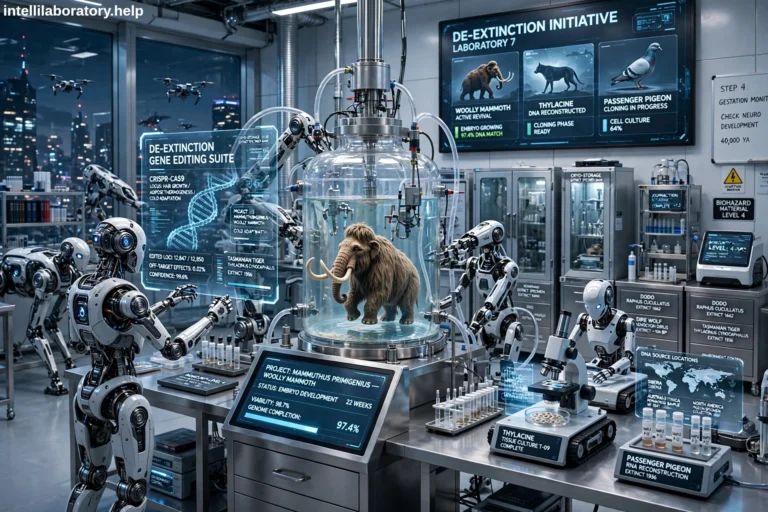
- Deeper Integration with Robotics: AI could guide autonomous robots in controlled environments (like labs or simulated dig sites) to handle delicate fossil preparation or excavation tasks.
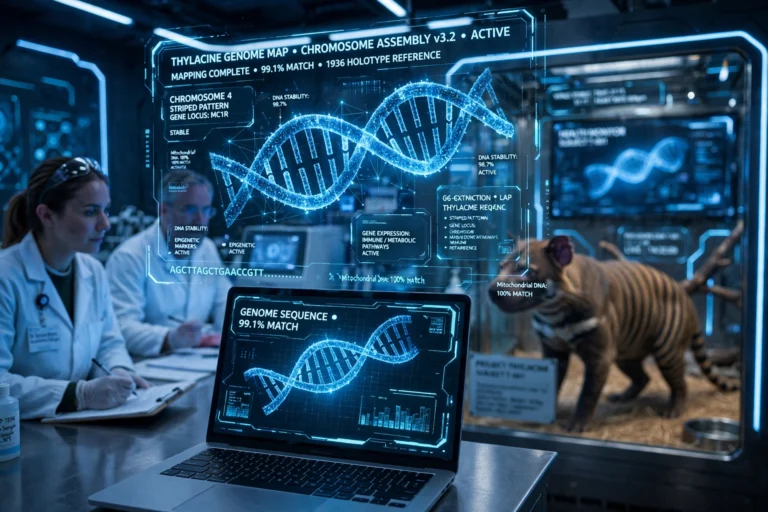
- AI-Assisted Synthesis: Combining fossil data with data from other Earth sciences (geology, climatology, genomics) using multi-modal AI to create a more holistic understanding of the past.
- Democratization of Discovery: More powerful, user-friendly AI tools could potentially allow citizen scientists or smaller institutions to analyze data in ways previously impossible.
- Ethical Considerations: As AI takes on more analytical roles, questions around data quality, potential biases in AI algorithms, and the interpretation
of AI-generated insights will become increasingly important.
The collaboration between dedicated AI laboratories and the field of paleontology is not just a technological novelty; it’s a powerful force reshaping how we explore and understand deep time. By augmenting human capabilities with machine intelligence, AI labs are accelerating discoveries, refining interpretations, and enabling entirely new ways to visualize and interact with Earth’s ancient history. While challenges remain, the potential for AI to unearth hidden patterns, predict future findings, and reconstruct lost worlds is immense. The excavation of the digital age is underway, and AI laboratories are leading the dig.
About the Author