Website Analysis & Project Overview: intellilaboratory.help
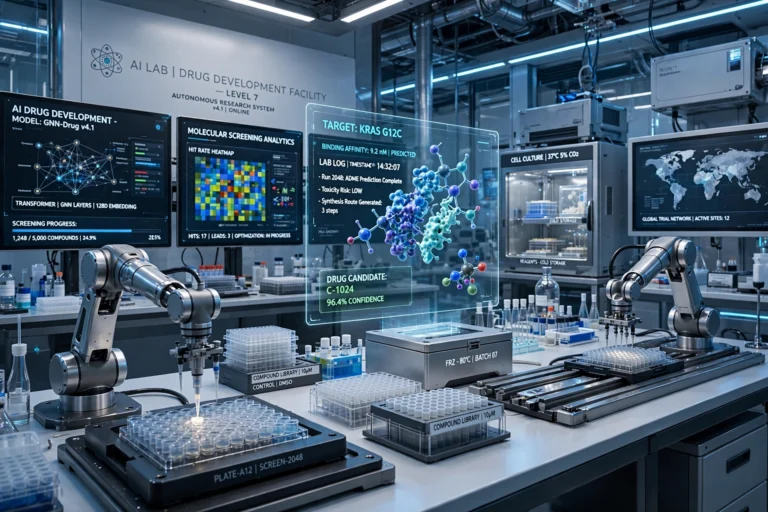
Core Concept: The website intellilaboratory.help serves as a hub for exploring, discussing, and showcasing projects related to the application of Artificial Intelligence, machine learning, advanced data analytics, and automation within laboratory settings (R&D, clinical, industrial).
Target Audience: Researchers, Lab Managers, Scientists, Data Analysts, Automation Specialists, Tech Developers, Students, Healthcare Professionals (clinicians using lab data), and Industry Leaders in biotech, pharma, materials science, and environmental science.
Website Goal: To position itself as a thought leader and resource, demonstrating practical applications and future possibilities of “smart” labs.
Intellilaboratory.help: Current & Planned Projects Showcase
Welcome to the project showcase page for intellilaboratory.help. This document outlines our current initiatives and exciting future plans. Our goal is to pioneer the development and implementation of intelligent systems that enhance efficiency, accelerate discovery, improve data quality, and ultimately transform laboratory workflows across various scientific disciplines. Below, you’ll find detailed descriptions of our projects, categorized for clarity.
Current Projects (In Development / Active)
These projects represent the core focus areas where we are actively applying AI and advanced technologies to solve real-world lab challenges.
1. Project: AI-Driven Experiment Optimization & Prediction (ADEX-P)
- Goal: To develop algorithms that can predict the outcomes of complex experiments and optimize experimental parameters in real-time.
- Application: Primarily R&D labs (pharma, materials science, biotech). Could also benefit clinical labs for diagnostic test development.
- Technologies: Machine Learning (Deep Learning, Reinforcement Learning), Data Analytics, Sensor Integration (IoL – Internet of Lab Things).
- How it Works (Concept):
- Collect vast amounts of data from ongoing experiments (e.g., chemical reactions, cell cultures, material properties).
- Train ML models to recognize patterns, correlations, and predictive markers.
- The system can then suggest optimal conditions for future experiments or predict potential failures/successes before running them.
- Potential Benefits:
- Dramatic reduction in trial-and-error time and cost.
- Ability to explore parameter spaces faster than manual experimentation.
- Improved reproducibility by standardizing optimal conditions.
- Discovery of unexpected or novel outcomes by identifying subtle patterns.
- Interesting Angle: Focus not just on prediction, but on real-time adaptive experimentation where the AI dynamically adjusts parameters mid-experiment based on live feedback.
2. Project: Predictive Maintenance for Lab Equipment (PREM-LAB)
- Goal: To create an AI system that predicts when lab equipment (like centrifuges, PCR machines, HPLC systems) is likely to fail, allowing for proactive maintenance.
- Application: All labs relying on expensive, mission-critical equipment. Reduces downtime, prevents sample loss, optimizes maintenance schedules.
- Technologies: IoT Sensors (vibration, temperature, power consumption, error logs), Time-Series Analysis, Anomaly Detection ML, Predictive Analytics.
- How it Works (Concept):
- Equip lab devices with non-invasive sensors to monitor operational health data.
- Continuously collect and analyze this data using ML models trained to identify patterns indicative of impending failure.
- Provide alerts and predictive scores to lab managers, enabling preventative maintenance.
- Potential Benefits:
- Minimize costly downtime and unexpected repairs.
- Extend lifespan of expensive equipment.
- Improve data integrity by preventing failures during critical runs.
- Optimize maintenance budgets by shifting from reactive to predictive schedules.
3. Project: Intelligent Data Harmonization & Analysis Platform (IDHAP)
- Goal: To develop a platform that can automatically integrate, clean, and harmonize data from disparate lab sources (instruments, LIMS/ELN systems, spreadsheets) and apply advanced analytics.
- Application: Labs with complex workflows, multiple instruments generating different data types, struggling with data silos and inconsistencies.
- Technologies: Data Engineering (ETL/ELT), Natural Language Processing (NLP) for unstructured data (protocols, notes), Data Warehousing, Graph Databases, ML for data imputation and correlation discovery.
- How it Works (Concept):
- Connect to various lab data sources (structured and unstructured).
- Use NLP and ML to understand data formats, identify inconsistencies, map related data points across systems.
- Automatically clean, standardize, and integrate data into a unified view.
- Offer tools for exploratory data analysis, identifying correlations and trends previously obscured by data fragmentation.
- Potential Benefits:
- Break down data silos, making lab data truly actionable.
- Save significant time spent on manual data cleaning and integration.
- Enable more comprehensive and reliable meta-analysis of lab data.
- Improve traceability and compliance by creating a single source of truth.
Planned Projects (Future Initiatives)
These projects represent our roadmap for the next 1-3 years, driven by emerging trends and anticipated needs in the intelligent lab space.
4. Project: AI-Powered Personalized Experimentation Guidance (APEX-G)
- Goal: To create an AI assistant that guides individual researchers through complex experimental workflows, suggesting steps, resources, and potential pitfalls based on their specific goals and the lab’s existing knowledge base.
- Application: Researchers in complex fields like drug discovery, synthetic biology, materials informatics.
- Technologies: Advanced NLP, Knowledge Representation (Graph Databases), Machine Learning (few-shot learning, transfer learning), User Interface/UX Design.
- How it Works (Concept):
- The system learns from institutional knowledge (publications, internal databases, successful/experimental protocols).
- Using NLP, it understands the researcher’s specific query or goal.
- It then provides tailored suggestions for experiments, reagents, techniques, and potential resources, drawing analogies from past successes or failures.
- Could integrate with ELN to provide context-aware recommendations.
- Potential Benefits:
- Accelerate the learning curve for new researchers.
- Help experienced researchers avoid common mistakes.
- Democratize access to sophisticated experimental knowledge.
- Streamline the ideation and planning phase of research.
5. Project: Automated Literature Review & Hypothesis Generation (ALR-HG)
- Goal: To develop an AI system that rapidly scans the scientific literature (publications, patents, databases) and generates novel, testable hypotheses relevant to specific research areas or ongoing experiments.
- Application: R&D labs, academic researchers, bioinformatics teams.
- Technologies: NLP (Text Mining, Entity Recognition, Relation Extraction), Knowledge Graphs, ML for pattern discovery, Information Retrieval.
- How it Works (Concept):
- Define a specific research domain or question.
- The system performs a deep scan of relevant scientific literature.
- Using NLP and ML, it identifies key entities, relationships, and knowledge gaps.
- It then synthesizes this information to propose novel combinations, interactions, or mechanisms worthy of experimental testing.
- Potential Benefits:
- Overcome the information overload problem in scientific research.
- Uncover interdisciplinary connections and novel ideas.
- Save researchers countless hours of manual literature review.
- Provide fresh perspectives and directions for experiments.
6. Project: Ethical AI Framework for Lab Automation (EAI-F)
- Goal: To proactively develop a framework and guidelines for the ethical deployment and operation of AI systems within laboratory environments.
- Application: All organizations implementing AI/automation in labs. Crucial for responsible innovation.
- Technologies: Ethics by Design principles, Transparency & Explainability (XAI) tools, Risk Assessment methodologies, Compliance frameworks (e.g., GDPR, GLP).
- How it Works (Concept):
- Identify potential ethical risks (bias in data/algorithms, job displacement concerns, data privacy, lack of transparency, accountability issues).
- Develop specific guidelines for data governance, algorithmic fairness, explainability requirements, human oversight protocols, and incident response.
- Create case studies and best practices for ethical implementation.
- Potential Benefits:
- Build trust in AI systems used in labs.
- Mitigate risks associated with biased or opaque AI decisions.
- Ensure compliance with scientific and data regulations.
- Position
intellilaboratory.helpas a leader in responsible AI for science.
intellilaboratory.help is committed to pushing the boundaries of what’s possible in the intelligent lab. Our current and planned projects span the gamut from optimizing existing processes and enhancing data utilization to guiding discovery and ensuring responsible innovation. We believe these initiatives will significantly impact scientific productivity, reliability, and the pace of discovery. We look forward to sharing more details as these projects progress and invite collaboration and feedback from the scientific community.